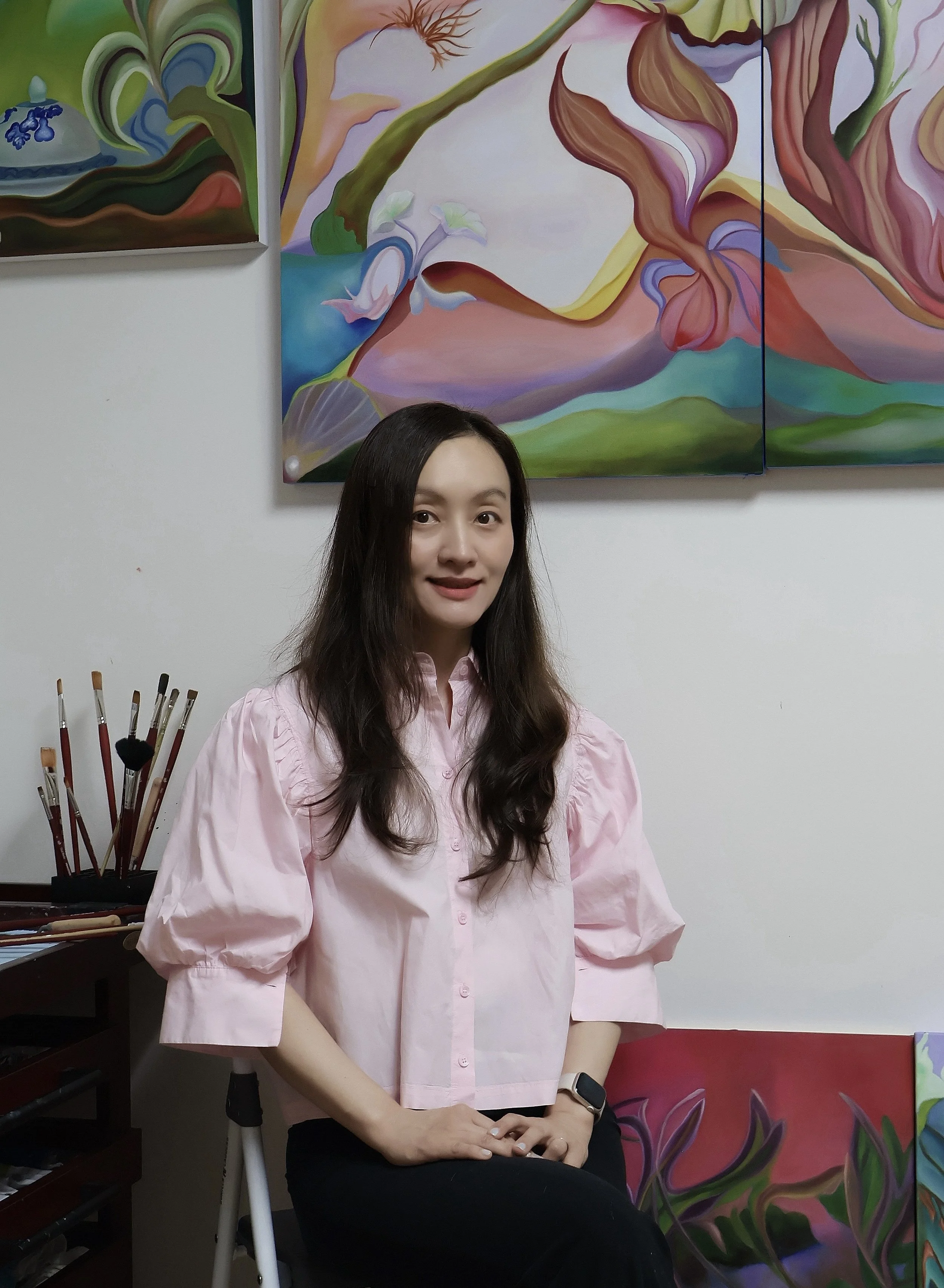
Bio
Yuan Butler (b. China) is a visual artist based in Duluth, Georgia. She earned an MFA in Painting from the Savannah College of Art and Design after immigrating to the United States in 2014. She works primarily in oil on large-scale canvas and wood panels. Her work draws from early training in drawing and traditional Chinese ink painting, shaping a practice grounded in memory and imagination. Butler is also a faculty member teaching art in Georgia Gwinnett College.
Butler has exhibited widely in the United States, and her work is held in both private and public collections. In 2023, she received the Cecile Adler Cliffer Memorial Cutting Edge Award from the National Association of Women Artists. In 2024, her work was featured in New American Paintings, MFA Issue 171. In 2025, her work was featured in “Of Land and Longing” by the Create! Magazine, and her series Four Seasons was acquired into the permanent collection by SCAD Museum of Art. In early 2026, her work was juried into New South 7 exhibition in Kailin Art.
Artist Statement
My work begins with a desire for dance, gestural lines that carry the body’s memory across the surface. I am drawn to moments that feel both restrained and powerful, like a quiet presence on stage. Painting becomes a space where movement is not performed but internalized.
Color is not decorative; it is an intimate call. I often begin with tensions: red and green, attraction and resistance, love and its opposite. These seemingly incompatible forces mirror emotional states I return to again and again. I am interested in the possibility of transformation—the ability to turn resentment into form, and form into something like love.
My process pulls me toward the past. Not in a literal sense, but toward a feeling of historical weight, moments suspended in time. In this suspension, I encounter emptiness, not as absence, but as a tool. It is a space that forces me to confront, to reshape, to translate memory into something visual.
I start with discomfort, colors that resist harmony, forms that refuse resolution. From there, I distort, adapt, and reconfigure. Painting becomes a negotiation between what was and what might be.
In this way, the work exists between past and future: a quiet attempt to hold tension, and to let it transform.